• About

Laura in Firenze

~ My travels, adventures and encounters in Florence and throughout Italy

Laura in Firenze

Monthly Archives: February 2015

The Palace of Escape from Boredom

24 Tuesday Feb 2015

Posted by lauradelaforgue in Uncategorized

≈ Leave a comment

I love Italian Renaissance frescoes. I can neither see enough of them nor learn enough about them. Therefore, before my last trip to Florence, I did some research and put together a list of frescoes that I wanted to view in Florence and in surrounding towns.  I was able to visit many of them and loved them all, but some of the frescoes that I loved the most were never even on my list. Those are the frescoes that embellish the Salon Dei Mesi (the Room of Months) within the Palazzo Schifanoia in Ferrara, Italy.

I was visiting my dear friends in Ferrara for the weekend and they, knowing how much I love Renaissance art and frescoes, took me to this palace.  I had never heard of this place nor these frescoes.  The meaning of the palace name is fascinating.  It was the leisure and pleasure palace of the d’Este family, headed by Duke Borso d’Este. The d’Estes ruled over Ferrara during the Renaissance period. The palace name is thought to originate from “schivar la noia”, meaning literally to “escape from boredom”.  What a fantastic name!

When I entered the Room of Months in the Palace of Escape from Boredom, I felt as though I had walked into a fantasyland. No one could be bored in this room! The room was once completely frescoed on all four walls with a series of panels representing each month of the year.  Sadly, the west and south walls are extremely damaged and deteriorated to the point that one can only see fragments.  The north and east walls, however, are in very good condition.  The north wall portrays the months of June, July, August and September and is believed to have been painted by Cosimo Tura.  The east wall is attributed to Francesco del Cossa. The east wall was the one that most captured my imagination.

AprilWall Schifanoiajpg

These frescoes are one of the most remarkable surviving works of the Ferrarese Renaissance artists. What struck me is that they are pagan.  I was so used to seeing religious themes in frescoes.  The purely pagan frescoes consist of three tiers for each month.  The top tier depicts mythology-an ancient diety in procession. The second tier depicts the zodiac symbol appropriate to that month, and the bottom tier shows the courtly activities of the d’Este court during that month.

Francesco del Cossa was born around 1436 and passed away at a young age of plague around 1478.  A letter was discovered in the late 1800’s which he had written to the Duke d’Este asking for more money for his work. After being refused, he left for Bologna in 1470.  Perhaps he would have completed more of the walls of the Room of Months had this not occurred.

Del Cossa’s April fresco segment was the most captivating to me.  The top panel depicts Venus, the goddess of spring and rebirth, riding a carriage that looks to be made of Christmas ribbon candy.  Her carriage is drawn by swans guided with red ribbons. There is a suitor kneeling before her, and she appears to be holding an apple or some type of melon. Doves fly above her head, young lovers gather all about – some embracing, some holding instruments. Rabbits and fauna abound and magical castles loom in the distance.  In the upper right corner there are three naked figures who I assume to be the Graces, as we see in Boticelli’s Primavera approximately a decade later. The entire scene is like a fairytale that draws one in and sparks the imagination.

PalazzoSchivanoia

The middle panel of April depicts the Zodiac figure of Taurus the Bull.

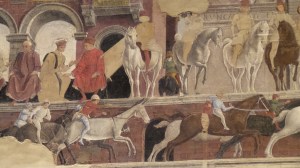
The bottom panel of del Cossa’s April is the one that depicts the allegorical scene of every day life.  His choice here is the Ferrara Palio.  The Palio is a festival of parades and competitions, culminating in a bareback horserace.  Siena’s palio is the most famous, but Ferrara’s is the oldest. The race is occurring at the top of the panel and at the bottom, courtiers gather and converse. There is one delightful figure of a man who sits at the edge of the fresco with his legs “hanging” over the edge.  It is a whimsical touch that brings even more life to the fresco.
20141128_153840

AprilWallCourtiersSchifanoia

I hope to return to the Palace of Escape from Boredom on my next visit to Italy.  Certainly not that I need an escape from boredom when in Italy, but because the Palazzo Schifanoia and it’s amazing fantastical, pagan, humanistic fresco cycle are thoroughly enchanting and captivating!
The Crucifix of Cimabue-Symbol of Tragedy and of Hope

23 Monday Feb 2015

Posted by lauradelaforgue in Uncategorized

≈ Leave a comment


The first time that I stood beneath Cimabue’s powerful depiction of Christ on the cross in the Basilica of Santa Croce in Florence, Italy, I was overwhelmed.  I was overwhelmed with grief and with hope.

What could cause one to simultaneously feel these conflicting emotions?  Cimabue’s crucifix has an amazing story to tell.

Cimabue was one of the most important artists of the 13th century.  Born around 1240, he began to break away from the Italian Byzantine style that had dominated Christian art in prior decades.

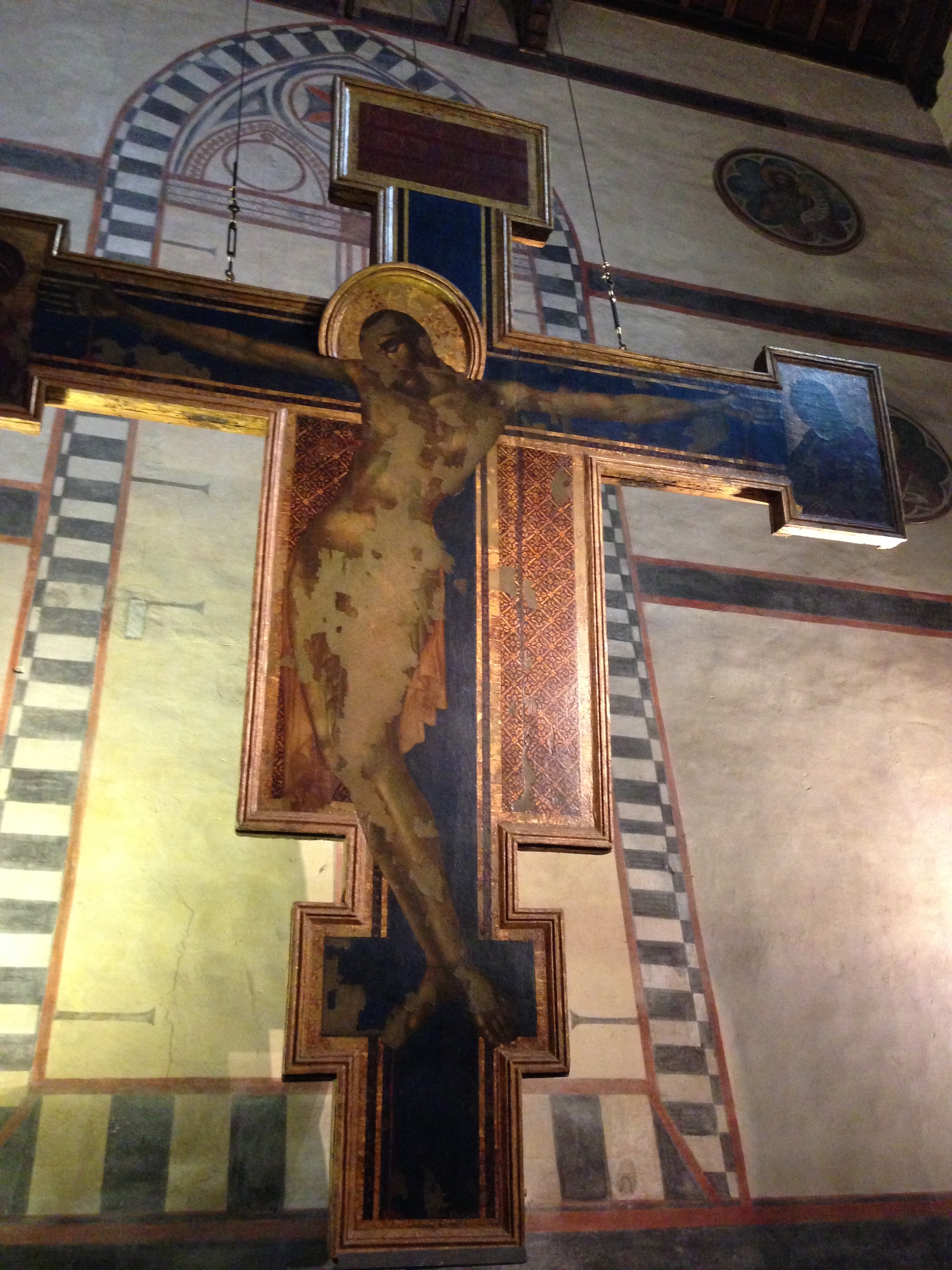
His crucifix, which hangs in Santa Croce, was probably painted around 1272. It is a magnificent piece of tempera on wood measuring 14′ 3″ X 12′ 7″. Today it stands alone and powerful under dramatic lighting.

Prior Italian Byzantine depictions of Christ on the cross presented a flattened, abstract figure showing little emotion. Cimabue’s Santa Croce Christ appears more natural and human.  His body is softer and more fluid.  Blood flows from his hands and feet. His arms are stretched out straight rather that sagging as in other depictions, helping to give the appearance of a floating figure. His hip touches the apron of the frame of the cross, as do his feet, giving the figure dimension and life. There is an elegance to his pose and his face is completely at peace. How can a painting that evokes so much peaceful emotion come to be a sign of tragedy?

Cimabue’s crucifix had survived nearly 700 years of floods and war.  It had suffered some flood damage in 1333 and in 1557.  During World War II, it was removed from Florence for protection. But on November 4th, 1966 the Arno River swelled and exploded beyond its’ banks, pouring gushing water and muck onto the city of Florence.  It was the most devastating flood since Cimabue had painted the masterpiece crucifix. Thousands of pieces of art and manuscripts were destroyed or damaged in the mighty flood. The Crucifix of Cimabue was one of the most damaged, and – aside from the tragic loss of lives – was probably the most precious casualty of the flood.

Nearly twenty feet of water filled Santa Croce and the magnificent Christ was covered in the mixture of water, mud and oil up to the nimbus. The cross was so soaked that it grew by 3″ and doubled in weight. Over 60% of its’ paint was lost – washed away and peeling.  The wood was cracked and mold was growing.  Cimabue’s suffering Christ was now suffering what appeared to be nearly irreparable damage.

This is the tragedy-now where is the hope?  Enter gli Angeli dei Fango–the Mud Angels.  Because of the fact that Florence holds such a wealth of the world’s beautiful art, the world came together to help clean up and restore the city and its’ treasures. Volunteers poured into the city and they became known as the Mud Angels.  Some of them waded through the water around the crucifix and picked up pieces of paint with pliers.

There was much controversy over restoration techniques and which to use on the piece.  It was finally decided to repaint it using a technique known as trattegio – a kind of hatching technique using a fine brush. It took years for the crucifix to dry out and return to its’ original size and weight.  It was not returned to public viewing until ten years later in 1976.

While the tragedy of Cimabue’s crucifix is heartbreakingly evident, the hope lies in the fact that it represents the coming together of so many souls and minds in an effort to restore it to its’ original glory. Today, the damage is extremely visible, but the energy and beauty that the piece emits are undeniable.  It is a beautiful symbol of survival and a combination of the talent of a 13th century master with the technology of the modern era and the passion of people who love the art of Florence with all of their hearts.

Cimabue


Subscribe

  • Entries (RSS)
  • Comments (RSS)

Archives

  • August 2016
  • March 2016
  • August 2015
  • April 2015
  • March 2015
  • February 2015
  • December 2014
  • November 2014
  • October 2014
  • September 2014
  • August 2014
  • July 2014

Categories

  • Uncategorized

Meta

  • Create account
  • Log in

Blog at WordPress.com.

Privacy & Cookies: This site uses cookies. By continuing to use this website, you agree to their use.
To find out more, including how to control cookies, see here: Cookie Policy
  • Subscribe Subscribed
    • Laura in Firenze
    • Already have a WordPress.com account? Log in now.
    • Laura in Firenze
    • Subscribe Subscribed
    • Sign up
    • Log in
    • Report this content
    • View site in Reader
    • Manage subscriptions
    • Collapse this bar
 

Loading Comments...